- Sector : Nature-based Solutions
- Location : Senegal
- Involvement : Technical Assistance
Executive Summary
The Subnational Climate Fund (SCF) is providing targeted technical assistance to establish whether an invasive aquatic plant could be managed as a commercially viable biomass resource in the Senegal River Valley. A pre-feasibility study delivered the first site-specific quantification of the exploitable Typha spp. (cattail) resource at Lac de Guiers and the left bank of the Senegal River, assessed the available valorisation pathways, screened the ecological risks of large-scale harvesting, and modelled the logistics and cost structure from harvesting through processing-unit intake.
The study estimated an exploitable resource of 175,000 to 260,000 tonnes of dry matter per year across the two sites, subject to significant variation by evaluation methodology, site and year. This evidence base supported the mobilisation of USD 50,000 in early-stage capital from private impact investors and other finance providers and informed the approval of a second technical assistance grant for a preliminary environmental and social assessment.
Project Status
Since the completion of the pre-feasibility study, Walorise has been transforming its model, partnerships and next-stage development activities. The project has secured through a letter of commitment of the Department, exclusive harvesting rights for the next 15 years to approx.. 10% of its affected zones – representing approx. 140,000 t of available biomass annually.
In addition, the project now incorporates rice husk as a second feedstock ro supplement the Typha feedstock during the Typha’s off-season, drawing on Senegal national rice husk potential. Now to the next stage of activities, Walorise is developing a platform delivering a dashboard allowing monetization layer of territorial resilience. Building on field-level climate community outcomes, the innovative technology will ne deliver verified data products for corporates, investors and public instutitons.
The project now aims to deploy a pilot-scale pyrolysis at selected site, prove Typha-to-biochar process, industial-scale testing of biochar quality, start agronomic trials derived from rice husk, as well as generate its first biochar carbon removal (BCR) credits.
The Challenge
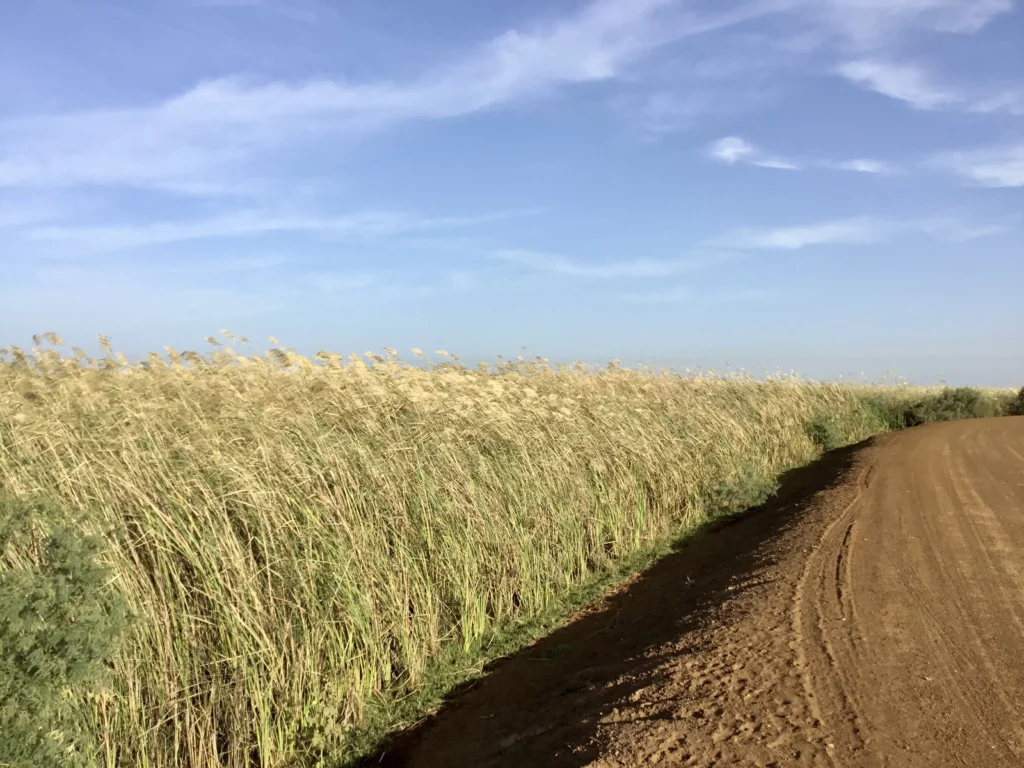
The proliferation of the reed Typha across the lower Senegal River basin has restricted fishing and farming areas, reduced water storage and conveyance capacity, threatened biodiversity, and affected the livelihoods of riparian communities. It is also associated with increased incidence of water-borne disease, including urinary and intestinal bilharzia. Lac de Guiers, a strategic source of drinking water and irrigation supply, has been materially affected.
The invasion is a recognised basin-level management priority. Controlling the proliferation of Typha in the lower basin, to a level at which it no longer threatens ecological balance and economic activity, forms a dedicated component of the World Bank-financed Senegal River Basin Integrated Water Resources Management Project implemented with the Organisation pour la Mise en Valeur du fleuve Sénégal (OMVS).
At the same time, Typha represents a largely unexploited biomass resource with potential applications in soil nutrition, energy recovery and materials. Converting an environmental liability into an investable resource requires credible site-specific data, tested technical assumptions and a defensible value-chain logic. Those conditions were not in place.
Technical Assistance
The Subnational Climate Fund intervened at pre-commercial stage to improve project readiness through a targeted pre-feasibility study. The work focused on the upstream components of a biomass value chain, combining a literature review with a site-specific case study.
Part 1: White paper on the use of Typha
- A consolidated summary of the current state of knowledge on Typha and its proliferation in the area: proliferation patterns and drivers, stakeholders impacted and involved, existing and planned management approaches, physicochemical properties of the material, and recovery potential.
- Collection and analysis of existing experience from projects using Typha to produce bioenergy and organic fertilisers in Senegal, to inform potential long-term investment.
- A comparative review of energy-recovery pathways — pyrolysis, gasification, biomethanisation, alcoholic fermentation and direct combustion — assessing the compatibility of each with Typha as a feedstock.
- A review of soil-nutrition applications, including compost, bio-fertiliser, buried manure, biochar and mulching, alongside other uses in construction materials, handicrafts, food and medicine.
Part 2: Case study of the Lac de Guiers sites and the left bank of the Senegal River
- Quantitative estimation of the volume of Typha that can be harvested at the two sites, including density mapping.
- Analysis of the sampling areas, with particular attention to the physical constraints affecting collection, such as water depth and accessibility.
- Identification and estimation of the ecological risks associated with large-scale Typha harvesting.
- Analysis of harvesting, drying and transport logistics to processing platforms, with the associated cost structures.
- An environmental screening of a proposed processing unit and a financial value-chain simulator covering harvesting through processing-unit intake.
Findings of the Pre-Feasibility Study
- Resource quantification. The exploitable Typha resource across the two studied sites was estimated at 175,000 to 260,000 tonnes of dry matter per year. The range reflects material variation by evaluation methodology, site and year-to-year conditions, and should be read as an order-of-magnitude planning basis rather than a firm supply commitment.
- Valorisation pathways. Energy recovery and soil-nutrition applications were assessed as co-equal pathways. Pathway compatibility with Typha as a feedstock varies considerably by conversion technology.
- Harvesting constraints. Water depth, site accessibility and seasonality directly affect harvestable volumes and unit costs, and are determinative for equipment selection and plant siting.
- Ecological risk. Harvesting at scale carries its own environmental and social risks to wetlands, biodiversity, hydrology, water quality and local users, distinct from the impacts of the invasion itself. These require structured assessment before design is fixed.
- Value-chain economics. Logistics, drying and transport represent a significant share of delivered feedstock cost, and were modelled to support credible revenue and return analysis.
Second Technical Assistance Grant: Environmental and Social Assessment
SCF has approved a second technical assistance grant financing a preliminary environmental and social assessment of the proposed harvesting activities, benchmarked against the IFC Performance Standards. The assignment will:
- review the environmental and social risks and positive impacts of Typha harvesting against the IFC Performance Standards;
- conduct a preliminary ecological and social baseline screening of the planned harvesting areas, including ecosystem services degraded by the invasion and expected to recover through restoration;
- assess residual risks to wetlands, biodiversity, hydrology, water quality and local users, building on the harvesting, machinery and logistics work already completed;
- identify safeguards, mitigation measures and monitoring requirements for responsible harvesting; and
- deliver a practical Environmental and Social Management Plan (ESMP) aligned with the IFC Performance Standards, setting out priority actions, responsibilities and timing.
Our Target Impact
-
SDG 13 Climate Action
Subject to access being formalised, the project targets harvesting across approximately 7,000 hectares, one cut a year at around 20 tonnes of dry matter per hectare, giving roughly 140,000 tonnes of biomass a year at full scale.
On that basis Walorise targets 30,800 to 35,000 tonnes of biochar a year from Typha and rice husk, with removal potential estimated at 77,000 to 87,500 tCO2 a year. These are projections contingent on access, on the pyrolysis pilot, and on certification that has not yet been sought.
-
SDG 8 Decent Work and Economic Growth
The project targets 300 to 500 formal jobs across the Typha value chain over the long term.
Yield improvements from biochar application are expected to give indirect benefits through income generation and lower fertiliser costs for farmers.
-
SDG 5 Gender Equality
Walorise intends to employ women and to involve women’s groups in distributing outputs such as biochar to farmers.
No gender baseline exists. The project will comply with the SCF Gender Policy.
The investment described above is a potential pipeline investment of SCF. There can be no guarantee that the investment will be completed on the terms described or implied above, that SCF will be able to successfully invest in such investment or that impact targets will be achieved.