- Sector : Sustainable Aquaculture
- Location : Mexico
- Involvement : Technical Assistance
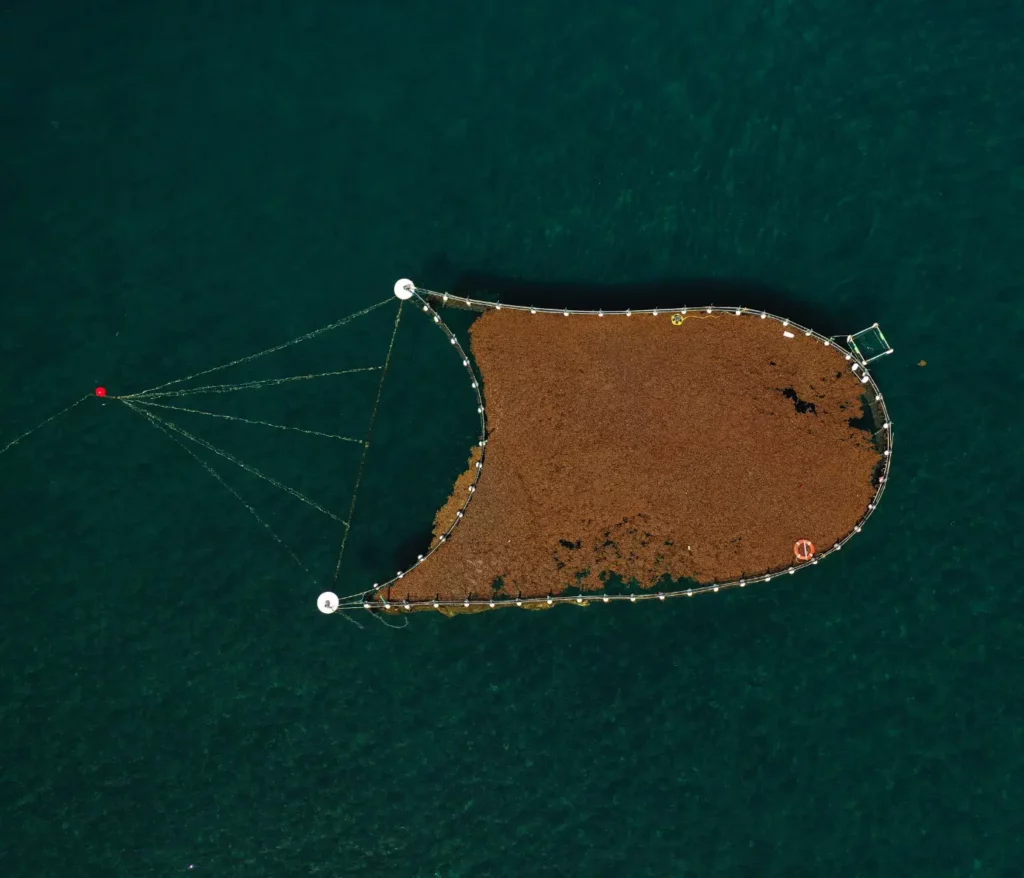
Image Credits: Seafields Nearshore AlgaePonix paddock, Seafields
Overview
Seafields has developed an integrated system to intercept sargassum nearshore before it lands. Floating barriers deflect incoming seaweed into in-water paddocks, where the biomass is kept alive rather than left to rot. The sargassum is then harvested and delivered to processors as feedstock for biostimulants, biochar and other bio-based materials. The intended revenue comes from three sources: fees for protecting coastlines, sales of the biomass, and carbon credits for the emissions avoided by preventing the material from decomposing on beaches or in landfill.
Seafields AlgaeponixTM prototype in-water paddock system has been tested in St Vincent and the Grenadines, in gentler water than Quintana Roo presents. In July 2026, the Subnational Climate Fund (SCF) approved technical assistance funding for two studies: one to establish whether the technology holds up as a deflection barrier and the commercial model is viable and, two, to establish any effect on the marine environment and surrounding coast.
The Challenge
Quintana Roo receives between 200,000 and 500,000 tonnes of sargassum a year. The state’s economy runs on tourism, and sargassum landings are estimated to reduce local economic output in affected areas by around 11.6%. The response today is almost entirely shore-based, beached sargassum collection, costing an estimated USD 0.3 to 1.5 million per kilometre a year. By then, the material is between 37% and 90% sand by weight, and the decomposing sargassum releases hydrogen sulphide and leaches arsenic into soils and groundwater.
Companies that can turn sargassum into something useful do exist and are scaling, but they cannot get a reliable supply of clean material because biomass collected off a beach degrades too quickly and carries too much sand. Furthermore, Sargassum arrives in fluctuating quantities. Intercepting the seaweed at sea has been shown to solve both the issue of coastal damage and the supply of fresh sargassum required for feedstock. Seafields in-water paddock would solve the reliability of supply but is yet to be integrated into a collection system.
Technical Assistance
The SCF Technical Assistance Facility, led by the International Union for Conservation of Nature (IUCN) in collaboration with Catalytic Finance Foundation and Gold Standard, is funding two independent studies, running in parallel and deliberately scoped not to overlap.
The gap they address is the distance between a prototype and a commercial system. The unit tested in St Vincent ran for four and a half months in conditions milder than the design is rated for and was made with 100% off-the-shelf components.
The system to be tested in Quintana Roo is assembled professionally with custom made buoys. Several different barrier component options are being tested to determine the materials best suited for a commercial system. Price, production time, quality and rate of repairs will be assessed. The site selected in Quintana Roo has stronger waves, currents and wind conditions than the previous test site allowing Seafields to determine the operational limit of the system.
Study 1: Engineering and commercial validation
A study to validate both the technology and the business model:
- What loads the structure faces, and whether the engineering meets them.
- How the barrier design performs across the range of wave and current conditions it will meet.
- Determine real operating limits, durability and maintenance needs in open coastal water.
- Whether nearshore collection, removal and transport to shore works as a repeatable operation.
- Whether coastal property owners and biomass buyers will commit and, at what price and terms.
- What the economics look like once the technical and commercial findings are combined.
Study 2: Environmental and coastal impact assessment
Study establishing what the system does to its surroundings:
- Whether the floating structure provides habitat or impacts marine life, including entanglement risk.
- What mitigation the design needs, and adequacy of the proposed measures.
- Whether the coastal conditions behind the barrier measurably improve against a comparable stretch without one.
The environmental study does not measure how much sargassum the barrier captures (this is part of the engineering study) nor replace the full environmental and social impact assessment required before any investment. Carbon certification is not assessed by either study. As the monitoring window falls in the low season for sargassum landfall, findings on coastal benefit will be provisional and will need testing at peak season. The project benefits from Quintana Roo currently allowing installation of Sargassum barriers without permitting.
Our Target Impact
-
SDG 13 Climate Action
At full deployment the project targets around 125,000 tCO2e a year avoided, by intercepting sargassum before it decomposes on beaches or in landfill. These are emissions that currently go unrecorded in national inventories.
Registration under Gold Standard’s sargassum macroalgae methodology is to be pursued, and baseline and emission factors have still to be validated against it. The figure is a projection for a project that is not yet financed or built.
-
SDG 8 Decent Work and Economic Growth
At full deployment the project targets 765 roles: 130 full-time direct jobs in collection, 135 temporary direct jobs in construction and installation, and 500 indirect jobs with processing partners.
Direct employees are to be paid above minimum wage on standardised pay scales with gender pay parity.
-
SDG 5 Gender Equality
Women make up 40% of the company’s management team and 57% of overall staff. The project is assessed as meeting three 2X Challenge criteria, covering leadership, employment and caregiving support.
A gender equity plan for 2025 to 2027 commits to targeted recruitment of women and young people across collection and logistics roles in Quintana Roo.
There can be no guarantee that the investment will be completed on the terms described or implied above, that SCF will be able to successfully invest in such project or that impact targets will be achieved.