- Sector : Waste Management
- Location : Ecuador
- Involvement : Technical Assistance
Overview
Baneco is developing a facility in Ecuador to process banana harvest residue, the pseudostems, stalks and leaves left behind after the fruit is cut, into fibre for moulded packaging and other industrial uses. The process is mechanical rather than chemical: no pulping chemicals, no bleaching, and water that can largely be recycled. Industrial trials with a moulded-fibre packaging manufacturer reached banana fibre incorporation of up to 60.6% while meeting the manufacturer’s quality specifications.
What the company cannot yet show is that the residue can be gathered reliably and affordably at industrial volume, or how much greenhouse gas the facility would actually avoid. In July 2026 the Subnational Climate Fund (SCF) approved technical assistance, not an investment, funding two studies to answer those two questions. The project is between pre-feasibility and feasibility stage.
The Challenge
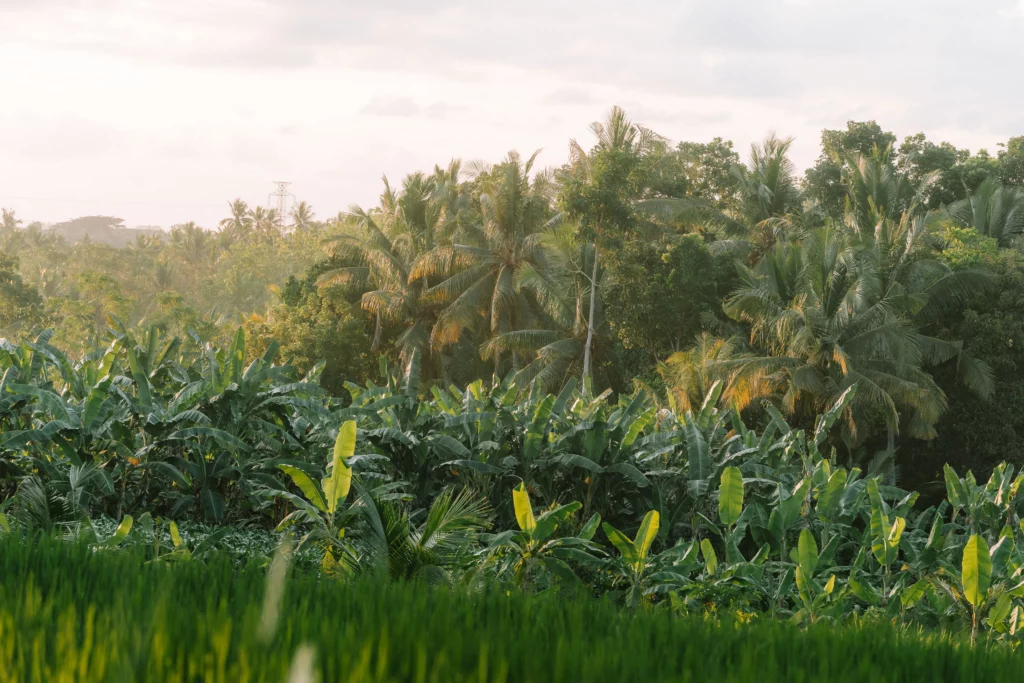
Ecuador is the world’s largest banana exporter, with roughly 200,000 hectares of registered plantations and around 5,400 producers, about 70% of national output coming from Los Rios and Guayas. Every harvest leaves behind several times the weight of the fruit in pseudostems, stalks and leaves. Almost all of it is left to rot in the field, burned, or landfilled. It earns growers nothing and emits methane as it breaks down.
At the same time, packaging and materials industries are pulling harder on tree-based fibre, with demand forecast to rise steeply over coming decades. Recycling cannot create new fibre, and non-tree alternatives have not reached commercial scale. Banana residue is an obvious candidate: abundant, year-round, and already aggregated at the point of harvest. What has never been proven is the middle of the chain, whether residue spread across thousands of smallholdings can be collected, moved and delivered to a plant at a cost and a reliability that an industrial buyer can build on.
Technical Assistance
The SCF Technical Assistance Facility, led by the International Union for Conservation of Nature (IUCN) in collaboration with Catalytic Finance Foundation and Gold Standard, is funding two linked studies. Both run to three months and both feed a single decision: which residue the facility should be built around.
Stalks are easier to collect. Pseudostems are heavier, wetter and harder to move, but they are also the fraction that emits most as it decomposes, so they may carry the larger climate benefit. The two studies test that trade-off from opposite ends.
Study 1: Feedstock supply and operating model
A pre-feasibility assessment of whether a reliable, affordable supply chain can be built:
- How much residue is genuinely recoverable, where it sits, and how it varies through the year.
- Whether to source stalks only or stalks together with pseudostems.
- How residue would be collected and aggregated, over what sourcing radius, and with what equipment.
- What feedstock costs delivered to the gate, and how that moves the cost of production.
- Which operating model keeps the plant running at usable capacity when supply fluctuates.
Study 2: Greenhouse gas baseline
An environmental and social study establishing the climate case, which does not currently exist in quantified form:
- What banana residue actually emits when left to decompose in Ecuadorian conditions.
- Whether the two sourcing scenarios differ materially in emissions avoided.
- What removing pseudostems costs the soil in organic matter and nutrients, set against the climate gain.
- Whether the additional emissions benefit is worth the additional collection cost.
What quantification method would hold up for future measurement, reporting and verification.
Together the studies produce a recommended sourcing strategy and a defensible emissions methodology. A full environmental and social impact assessment, including labour and supply chain due diligence across the banana sector, sits outside these studies and is required before any investment decision.
Our Target Impact
-
SDG 13 Climate Action
The expected benefit has two parts: emissions avoided when residue is diverted from unmanaged decomposition, and emissions displaced when banana fibre substitutes for higher-impact tree-based fibre in packaging.
No baseline emission factor, annual tCO2e estimate or calculation method has been established. The appraisal records this as a material data gap.
-
SDG 8 Decent Work and Economic Growth
Growers currently earn nothing from residue, so a paid feedstock stream would be new income from an existing waste product.
Expected roles span collection and logistics, machine operation, quality control, maintenance and administration. Job numbers are to be confirmed and depend on the operating model the first study recommends.
-
SDG 5 Gender Equality
Baneco is women co-led, with a co-founder holding meaningful equity and leading grower recruitment, supply relationships and delivery in Ecuador. Workforce commitments are stated intentions at this stage.
The investment described above is under development by SCF. There can be no guarantee that the investment will be completed on the terms described or implied above, that SCF will be able to successfully invest in such investment or that impact targets will be achieved.