
- Sector : Sustainable Agriculture
- Location : South Africa
- Involvement : Technical Assistance
Overview
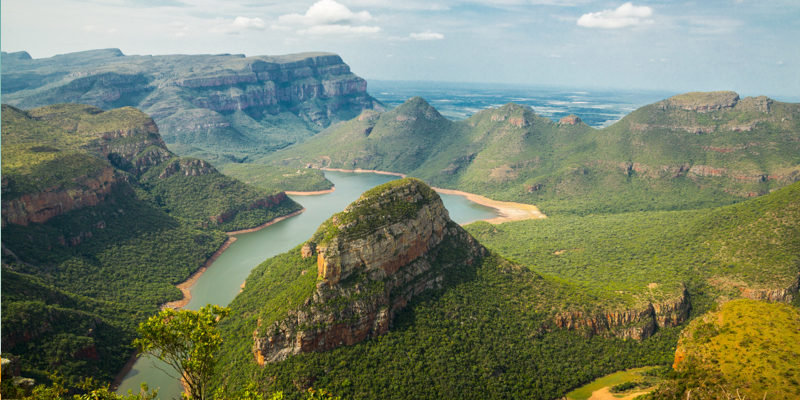
SCF is providing technical assistance to TERRAGRN, a private sector enterprise cultivating & operating large biodiverse agroforests. In South Africa, over the next 5-6 years, TERRAGRN aims to grow an agroforest on approx. 200,000 ha on unutilized land in the major coal mining province Mpumalanga with the objective to create new jobs and to produce green energy.
The agroforest will include:
➢ 40% bamboo plants (non-invasive, clumping varieties) to produce pellets, pulp, biochar and activated carbon for industrial customers.
➢ 40% fruit trees and food/ cover crops (citrus fruits, olives, apricots, pecan nuts, cereal crops for community sustenance and commerce).
➢ 20% other indigenous trees
The forest would be FSC, SBP and PEFC certified. Bamboo is widely recognized as an effective & highly renewable tool for climate change mitigation (it emits 35% more oxygen than other plants and absorbs 40% more CO2). It also has a good potential for generation of thermal energy and electricity through gasification (comparable to wood + timber).
More recently
TERRAGRN Private Limited has been selected as one of 11 global winners of the World Economic Forum UpLink Scaling Land Restoration Innovation Challenge 2026. Selected from more than 210 applicants globally, TERRAGRN was recognised for its approach to scaling landscape restoration by combining ecological restoration with productive value chains, multiple income streams and community economic development. The recognition highlights TERRAGRN’s potential to demonstrate how restoration can move beyond individual projects towards a scalable and resilient business model capable of attracting long-term private capital.
The Challenge
South Africa faces a convergence of challenges that threaten both rural livelihoods and long-term economic resilience. Smallholder farmers across provinces such as Mpumalanga and Limpopo continue to face limited market access, fragmented value chains, declining soil quality, and increasing climate-related risks, resulting in low productivity and constrained income opportunities. At the same time, the country is seeking to strengthen food security, accelerate rural economic development, and diversify its energy mix through sustainable, locally sourced renewable energy solutions.
While bamboo presents significant potential as a climate-smart crop—offering carbon sequestration, land restoration benefits, sustainable biomass production, and opportunities for value-added processing—the commercial viability of integrated bamboo agroforestry systems remains largely untested at scale in South Africa. Key questions remained around feedstock performance, market opportunities, smallholder integration, operational models, and the ability to attract investment capable of supporting large-scale deployment.
Technical Assistance
TERRAGRN received two targeted technical assistance grants from the Subnational Climate Fund (SCF), awarded in 2022 and 2024, to undertake specific feasibility studies supporting its work in South Africa:
Bamboo Gasification Feasibility Study (2022)
Conducted with the Indian Institute of Science, the study validated Bambusa balcooa as an effective feedstock for gasification and power generation. Testing also identified residual char with potential for further value-added applications.
Women and Youth Smallholder Food Security & Livelihoods Study (2024)
The study developed an approach to strengthen food security and sustainable livelihoods for women and youth smallholder farmers in South Africa, combining regenerative multi-crop farming with shared infrastructure, market aggregation and downstream value-chain access. It also identified opportunities for additional income streams from agricultural waste, biochar and carbon credits.
Our Target Impact
-
SDG 7 Affordable and Clean Energy
The project is expected to produce 1.8bn KWh/y of renewable energy.
-
SDG 8 Decent Work and Economic Growth
The project should create 50,000 new jobs in the agroforestry sector in rural areas of Mpumalanga province by 2030, including 10,000+ new jobs across bamboo value chains (plant tissue culture facility, downstream manufacturing, logistics). The project will hire 300 local women as entrepreneurs who will lead forest development & operations.
-
SDG 11 Sustainable Cities and Communities
Increased agricultural productivity should enable additional incomes for small-scale food producers due to increased rainfall, improved soil health, soil structures and soil nutrients
-
SDG 13 Climate Action
We expect the project to allow for the sequestration of approx. 300 million t of CO2 from 2023-2050, average of 10 million t/y.
Additionally, Bamboo pellets can reduce the use of coal if co-fired in industrial coal boilers or replace wood pellets in pure biomass boilers. Black pellets can be used in Cement sector to substitute coal with biomass in kilns.