- Sector : Sustainable Agriculture
- Location : Java, Indonesia
- Involvement : Technical Assistance
Overview
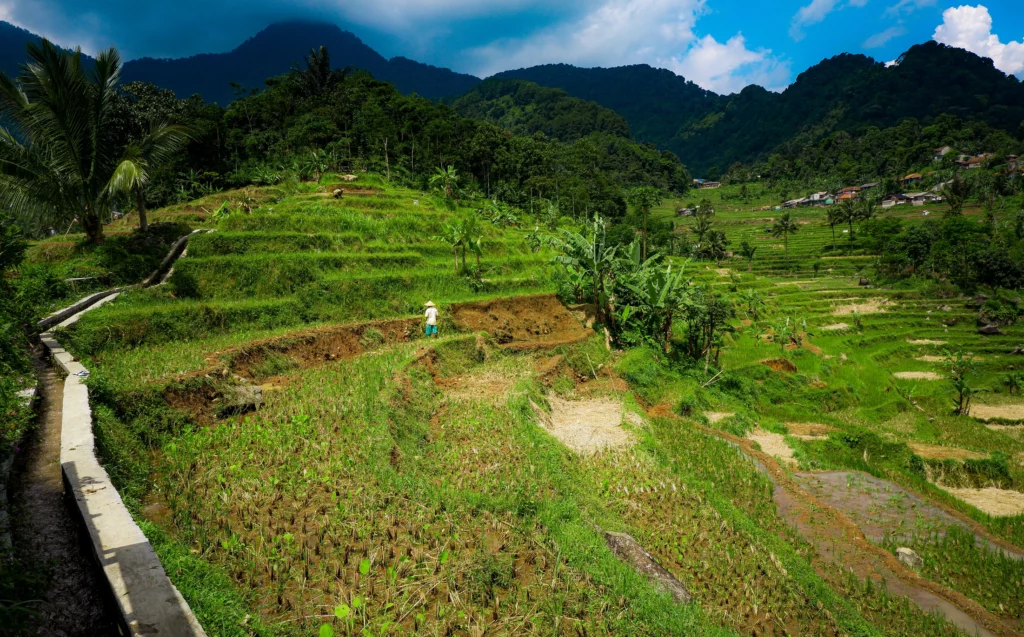
Rize is an agricultural services platform working with smallholder rice farmers in Indonesia and Vietnam. It provides input financing, agronomic advice, market linkage and offtake, and supports Alternate Wetting and Drying (AWD), an irrigation practice that lets paddies dry between floodings and cuts methane emissions. All of it is backed by field-level data systems for measurement, reporting and verification (MRV).
Rize now wants to know whether two durable carbon removal pathways, Enhanced Rock Weathering (ERW) and biochar, can be delivered through that same farmer network.
The SCF Technical Assistance Facility, led by the International Union for Conservation of Nature (IUCN) in collaboration with Catalytic Finance Foundation and Gold Standard, is funding a six-month feasibility study to assess the technical, operational, agronomic and economic viability of deploying ERW and biochar through Rize’s smallholder farmer network in Java. The technical assistance comprises two components.
The challenge
Rice cultivation releases approximately 1.1 gigatonnes of CO2 equivalent a year, mostly methane from flooded paddies, with more than 90% of it in Asia. Indonesia is the world’s fourth largest producer, and close to 60% of its output comes from Java. Around 80% of global rice is grown by smallholders on plots often under one hectare, where limited mechanisation, unreliable irrigation and volatile input costs push farmers toward short-term risk management rather than investment in soil. Rice straw is burned rather than used.
For both ERW and biochar, the obstacle is rarely the science. It is operational: aggregating feedstock, moving material to fragmented plots inside a narrow agricultural window, applying it consistently, and measuring the result to a standard a carbon buyer will accept. An established agronomy network already holds those capabilities, which is what makes the combination worth testing rather than assuming.
Technical Assistance
The SCF Technical Assistance Facility, led by the International Union for Conservation of Nature (IUCN) in collaboration with Catalytic Finance Foundation and Gold Standard, is funding the study. It has two components.
Component 1: Enhanced Rock Weathering Feasibility
The study will assess whether Enhanced Rock Weathering (ERW) can be technically, operationally and commercially deployed across Rize’s smallholder rice network in Java. It will:
- Identify suitable deployment areas and feedstocks, matching rice-growing agro-ecological zones with potentially suitable local rock sources based on soil conditions, mineral composition, availability and processing requirements.
- Assess agronomic performance, including potential effects on soil fertility, nutrient availability, fertiliser requirements and crop yields, and identify parameters requiring validation through future field pilots.
- Evaluate the ERW supply and application model, covering sourcing, crushing and processing, quality control, transport, storage and field application, including the infrastructure and service providers required for deployment.
- Assess economic and financial viability, including unit economics, value-chain costs, potential agronomic benefits, carbon revenues and sensitivity to application rates and carbon prices.
- Assess farmer adoption, including perceptions, willingness to participate, operational barriers and potential financing or incentive mechanisms.
- Develop an MRV and carbon-market pathway, identifying the data, measurement and verification requirements needed to quantify durable carbon removals and support potential future carbon-credit issuance.
The study will conclude with a recommended deployment and pilot roadmap, identifying priority locations and feedstocks, key risks and conditions for viability, and the next steps required to progress towards implementation and scale-up.
Component 2: Scalable Biochar Model
The study will assess whether rice residues from Rize’s farmer network can support a scalable biochar production, distribution and application model in Java. It will:
- Assess rice-straw availability and sustainable sourcing, including current residue-management practices, seasonality, competing uses, potential collection and aggregation points, and the quantities that could be removed without adversely affecting soil health.
- Design the distribution and on-farm application model, assessing transport, storage, timing, equipment, labour and potential roles for farmer organisations, aggregators and local service providers.
- Assess and shortlist suitable pyrolysis technologies, taking account of rice-straw characteristics, production scale, capital and operating costs, emissions control, operational requirements and local serviceability, and characterise the resulting biochar for agronomic and carbon-accounting purposes.
- Evaluate value-chain economics, including feedstock collection, processing, logistics, pyrolysis, distribution and application costs, alongside potential value from carbon credits, agronomic benefits and reduced input requirements.
- Develop an MRV and carbon-market pathway, covering feedstock traceability, production data, biochar characteristics, application records and the measurement and verification requirements for potential carbon-credit generation.
- Test agronomic performance through a small-scale field pilot, assessing the effects of different biochar application rates on crop performance, soil properties and indicative economics.
- Assess farmer adoption, including willingness to use biochar, practical and economic barriers, and potential service-delivery and financing mechanisms.
The work will result in a recommended scalable biochar model and implementation roadmap, identifying priority feedstock areas, preferred production and distribution approaches, key viability conditions and the further pilot activities required before larger-scale deployment.
Our Target Impact
-
SDG 13 Climate Action
Biochar is estimated to sequester approximately 2–3 tCO2e per tonne applied; ERW removes carbon through silicate weathering on a 1,000+ year timescale. Volumes for both pathways are what this study is designed to establish.
The existing AWD programme targets an estimated 80,000–240,000 tCO2e avoided per year at its 2026 coverage target, against a continuously flooded baseline.
-
SDG 8 Decent Work and Economic Growth
Targets farmer income improvements of up to 30% through lower input costs, maintained yields and future carbon revenue, plus more than 100 local agronomist roles.
Input financing repaid against the harvest cycle is designed to build formal credit history for smallholders with no access to commercial lending.
-
SDG 6 Clean Water and Sanitation
AWD is estimated to save 15–20% of irrigation water per hectare (SDG target 6.4) in one of the region’s most water-intensive production systems.