Recycling plastics in East Java: Lessons for project developers and investors
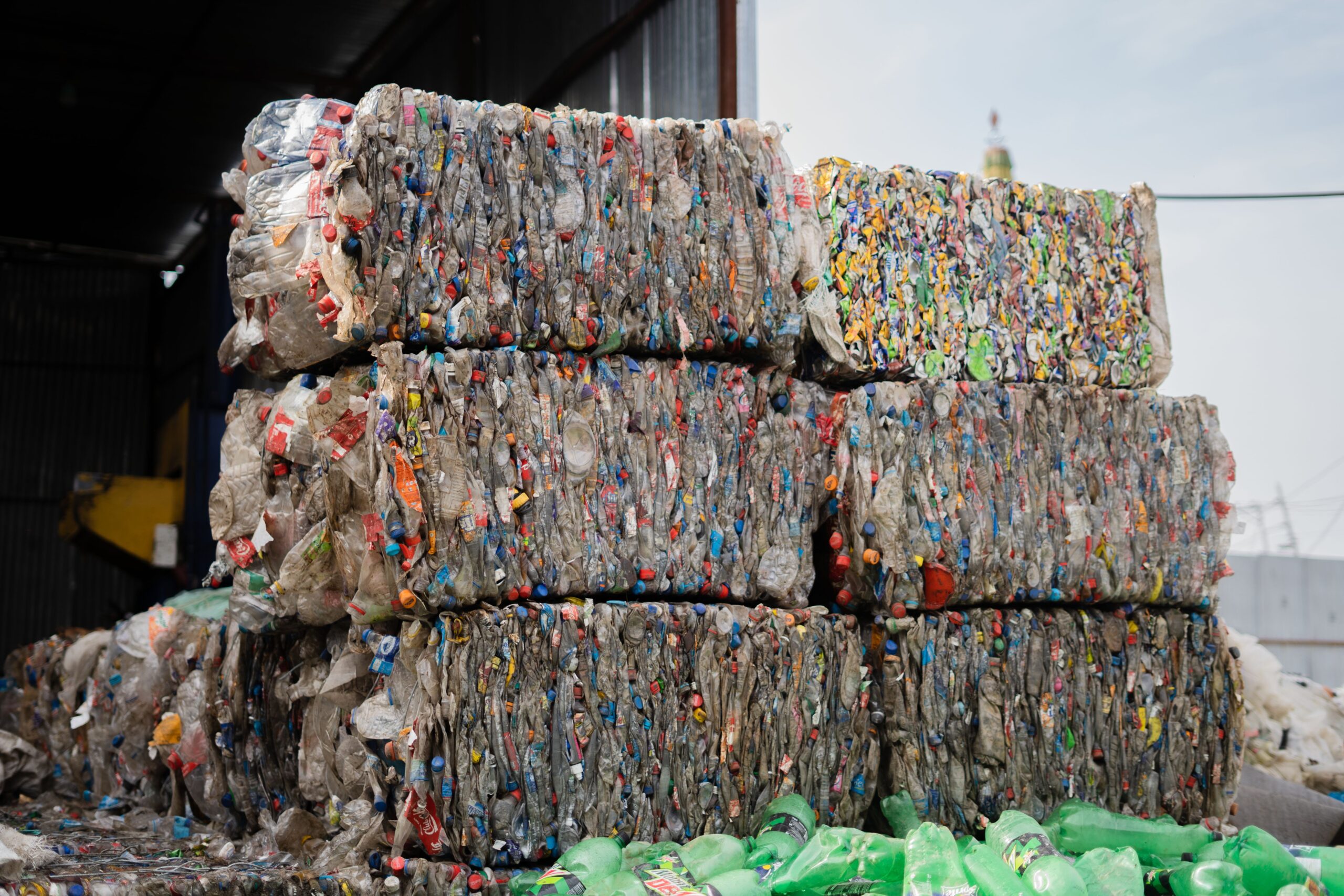
Image credits: Stacked compressed plastic bottles at a recycling facility, ready for processing. Photo by Gaurav Ranjitkar.
A feasibility study for a greenfield plastics recycling facility in East Java, Indonesia, finds that the technology is the easier part. Success depends on securing feedstock at the right cost and quality, and on the price of the virgin plastic that recycled resin competes with. The study assessed the technical and techno-economic feasibility of a mechanical recycling plant, covering the full chain from sorting plastic waste to producing recycled resin (recyclate) that manufacturers can use. It was commissioned by the Subnational Climate Fund (SCF) Technical Assistance Facility.
Feedstock matters more than technology
Experts consulted for the study agreed that, for most recycling projects in Indonesia, the strongest predictor of success is access to feedstock of the right quality and quantity. A plant with average technology and guaranteed feedstock usually outperforms a technologically superior plant that depends on uncertain waste collection volumes. In emerging markets, a plant’s location must allow feedstock supply to be optimized and to remain stable over time, not only offer affordable land.
Low-cost feedstock exists, but it is hard to organize
Indonesia’s plastic waste prices are competitive by regional standards. During site visits, community waste banks were buying plastic waste from residents at around 2,000–3,500 Indonesian rupiah (IDR) per kilogram. But volumes at each point are small and hard to organize, so most material moves through aggregators. They consolidate supply into usable quantities, but transport and logistics push their prices significantly up.
Sourcing directly from informal sector, waste banks and integrated waste processing sites (TPSTs) is the main upside for the business case. Training and education at these collection points can help secure both price and supply, and long-term supply relationships can give waste collectors more stable income.
The price of virgin plastic sets the ceiling
Recycled resin must compete with the price of virgin plastic made from fossil fuels. In the first half of 2026, supply chain bottlenecks in the Strait of Hormuz pushed Indonesian virgin polyolefin prices up by as much as 80%, to a peak near up to USD 1,800 per ton. Indonesia relies on the Middle East for roughly 55-60% of its virgin plastic raw materials.
Prices have eased slightly but remain structurally high, and long-term levels are lower. Typical long-term global ranges are USD 900–1,300 per ton for polypropylene and USD 1,000–1,500 per ton for high-density polyethylene. With operating costs estimated from USD 500–900 per ton depending on feedstock type, a plant can compete, but the margin narrows when virgin plastic is cheap.
Quality determines price
Local recycled resin sells for roughly USD 530–1,100 per ton, depending on material and color. The selling price of each recyclate compared to virgin plastic and the feedstock cost are the key drivers of long term competitiveness. That is why the plant design focuses on quality consistency: hand sorting combined with separate cold and hot washing lines for different feedstocks, optical flake sorting for material and color, and melt filtration and degassing during extrusion.
Moisture and residual contaminations in feedstock are practical examples impacting the process, yield and cost. Plastic waste delivered in Indonesia typically carries 5–10% moisture, varying between dry and rainy seasons, and the number of other contaminations, typically organic like food residues, can be quite high for the post-consumer waste originating from households.
Design for flexibility and resource efficiency
Waste streams change over time. The study recommends modular lines, intermediate storage with back-up, and design capacities based on a realistic mass balance rather than suppliers’ nameplate figures. Closed-loop process water systems allow water to be reused for as much as possible, which matters at sites without sewerage. Early planning for logistics, odor, noise, fire protection and working conditions avoids costly changes later.
Policy support helps
Indonesia offers fiscal and non-fiscal incentives for manufacturing, resource efficiency and circular economy investment through the Ministry of Investment (BKPM) and local governments. These can include tax holidays and allowances, accelerated depreciation, import duty exemptions, simplified licensing, and support for energy and road infrastructure. Regulatory drivers such as extended producer responsibility (EPR) schemes are expected to support demand for recycled material.
About the Subnational Climate Fund
The Subnational Climate Fund is a blended-finance initiative supporting mid-sized infrastructure projects and companies in emerging markets. Through its Investment Fund and Technical Assistance Facility, SCF strengthens project fundamentals, enhances investment readiness and mobilises private capital for sustainable development outcomes across sectors including sustainable energy, waste management and regenerative agriculture. By focusing on early-stage project preparation, SCF bridges ambitious climate and nature objectives with the requirements of institutional investors, development finance institutions and philanthropic capital providers.
Discover our other articles