New Research Validates a Digital Twin for Electric Mobility Investment in Sub-Saharan Africa
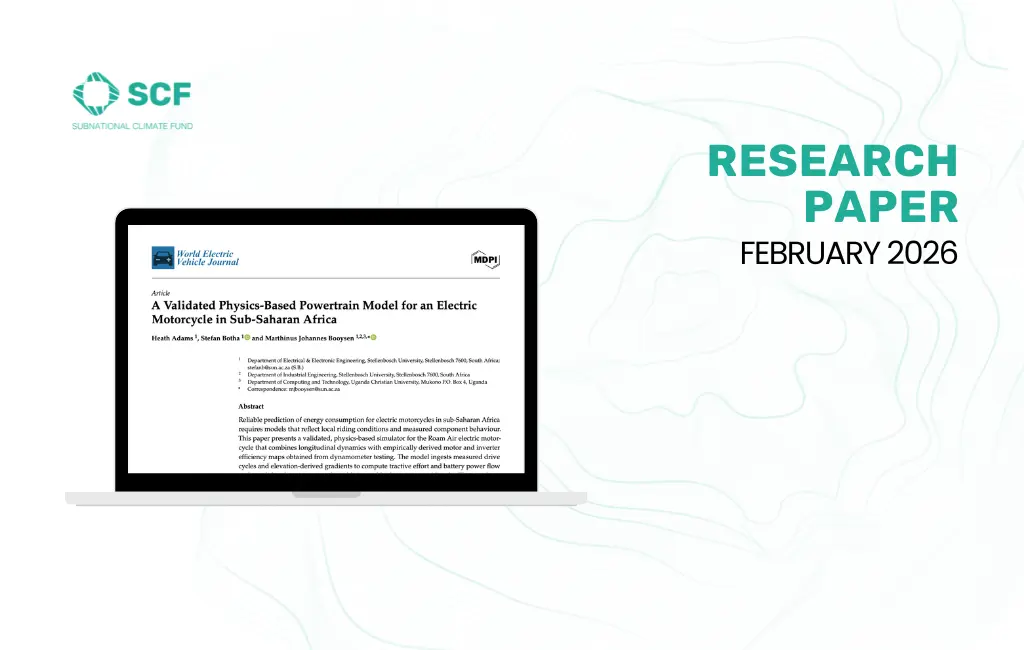
A significant milestone has been achieved in the electrification of two-wheelers in sub-Saharan Africa with the release of the first validated results from the Roam Air electric motorcycle project. This study, a collaboration between the Electric Mobility Lab at Stellenbosch University and Roam (Kenya), presents a validated, physics-based digital twin model that simulates energy consumption under real-world operating conditions. Supported by a grant for a feasibility package, this work aims to prepare Roam’s project for full-scale localized manufacturing and Industry 4.0 adaptation while reducing technical uncertainty or improving technical efficiency/vehicle performance.
Subnational projects in emerging markets often face significant structural barriers that prevent them from reaching financial close. In the case of Roam, limited data for accurately predicting energy consumption in local conditions posed a challenge, contributing to difficulty in securing investment for scaling up the project.
To address these barriers, the Subnational Climate Fund (SCF) provided targeted technical assistance to mitigate the financial, legal, regulatory, and technical risks. Through the development of a physics-based simulator for the Roam Air electric motorcycle, SCF supported the integration of longitudinal vehicle dynamics with empirically derived motor and inverter efficiency maps. The model was calibrated using real-world data from trips in Nairobi, ensuring it accurately reflected local operating conditions and providing a clearer picture of the project’s potential for sustainable, scalable growth in Sub-Saharan Africa.
With this validated model, the project has seen a significant shift in its readiness profile. Strong alignment between simulated and measured battery power profiles demonstrated that the project could now accurately predict energy consumption, addressing a key technical risk. This increased confidence in the project’s viability has made it investment-ready, enabling the next step in scaling and local manufacturing, with plans for wider regional deployment.
The project aligns with climate and development goals, such as reducing emissions and creating sustainable transportation solutions for sub-Saharan Africa. SCF’s catalytic assistance has contributed the potential for capital mobilization, laying the foundation for the project’s success in driving sustainable change.
Collectively, these efforts underscore the power of industry-academia partnerships in advancing sustainable mobility solutions, with Roam’s contribution of motorcycles and Stellenbosch University’s experimental support playing essential roles.
About Electric Mobility Lab at Stellenbosch University
The Electronic Systems Laboratory is a postgraduate research laboratory focusing on autonomous vehicles, housed within the Electrical and Electronic Engineering Department of Stellenbosch University, South-Africa.
About the Subnational Climate Fund
The Subnational Climate Fund (SCF) is a global blended finance initiative that aims to invest in and scale mid-sized (5 – 75 M $USD) sub national infrastructure projects in the fields of sustainable energy, waste and sanitation, regenerative agriculture and nature-based solutions in developing countries.
Discover our other articles